# Gertler & Karadi (2011) First order conditions
**URL:** https://forum.dynare.org/t/gertler-karadi-2011-first-order-conditions/22219
**Category:** Replication Attempts
**Created:** [3 April 2023 16:38 UTC](https://forum.dynare.org/t/gertler-karadi-2011-first-order-conditions/22219 "2023-04-03T16:38:19Z")
**Posts on this page:** 11
**Page:** 1
### Author:  [@Robert](https://forum.dynare.org/u/Robert)
#### Post date: [3 April 2023 16:38 UTC](https://forum.dynare.org/t/gertler-karadi-2011-first-order-conditions/22219/1 "2023-04-03T16:38:19Z")
Hi everyone,
This is a quick questions for all those who have replicated or worked with the Gertler & Karadi (2011) unconventional monetary policy model.
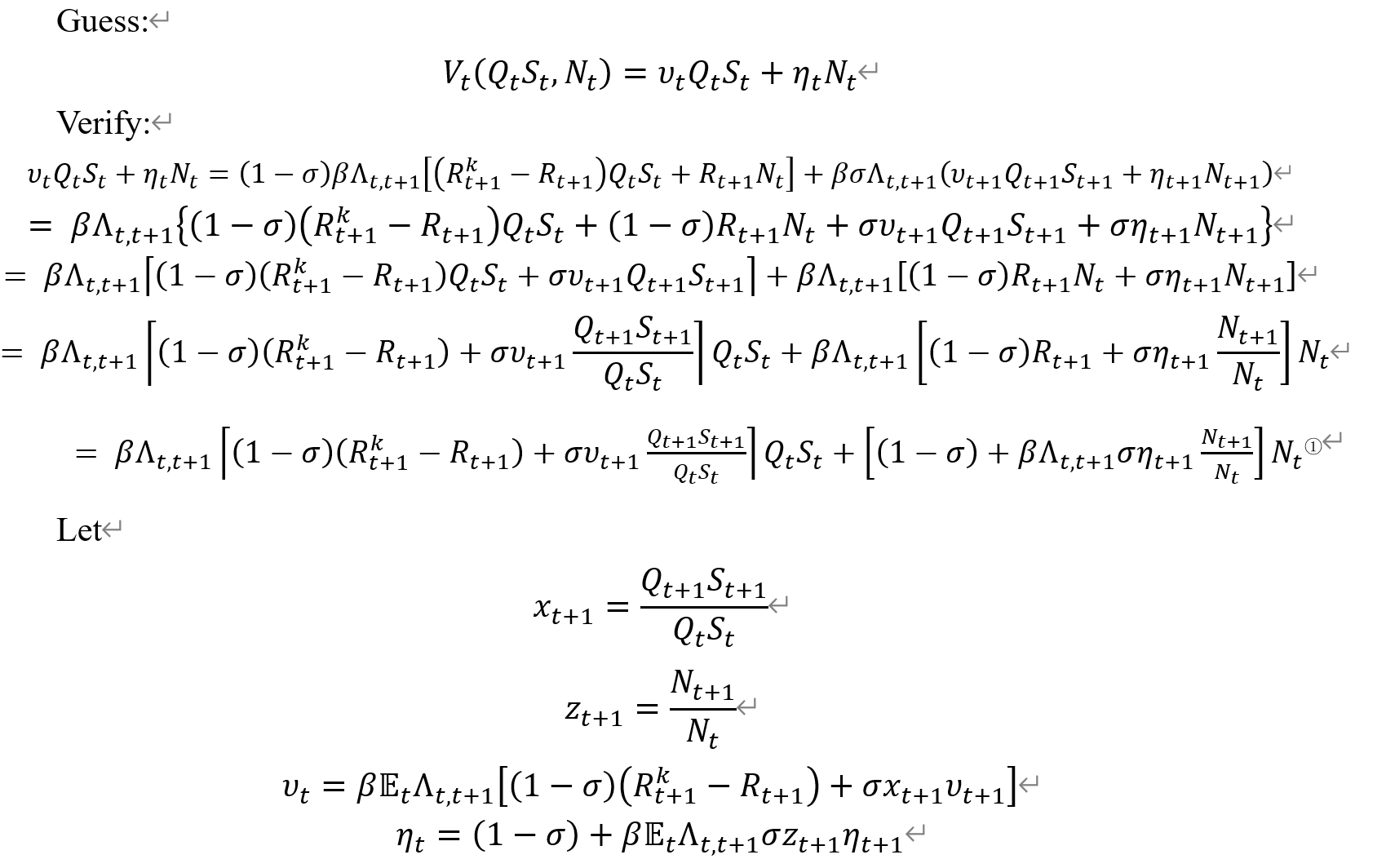
I am currently trying to understand the code which in turn means making sense of the FOCs. At the moment I am having to trouble to understand where the two equations under condition (11) come from:
\nu\_t = E\_t \Big[(1-\theta) \beta \Lambda\_{t,t+1} (R\_{k,t+1} - R\_{t+1}) + \beta \theta x\_{t,t+1} \Lambda\_{t,t+1} \nu\_{t+1} \Big]
and
\eta\_t = E\_t \Big[(1-\theta) + \beta \Lambda\_{t,t+1} \theta z\_{t,t+1} \eta\_{t+1} \Big]
In the paper it says: “The variable \nu\_t has the interpretation of the expected discounted marginal gain to the banker of expanding assets Q\_t S\_{j,t} by a unit, holding net worth N\_{j,t} constant, and while \eta\_t is the expected discounted value of having another unit of N\_{j,t}, holding S\_{j,t} constant.” The discounted lifetime net worth of the banker is expressed as:
V\_{j,t} = \max E\_t \sum\_{i = 0}^{\infty} (1-\theta) \theta^i \beta^{i+1} \Lambda\_{t,t+1+i} \Big[(R\_{k,t+1+i} - R\_{t+1+i}) Q\_{t+i} S\_{j,t+i} + R\_{t+1+i} N\_{j,t+i} \Big]
I was therefore thinking this expression above just gets maximised w.r.t. to Q\_t S\_{j,t} and N\_{j,t}, but it turns out this is not the case (or I am wrong). Any help would be greatly appreciated where condition (11) in the paper comes from. Many thanks!
Rob
---
### Author:  [@jpfeifer](https://forum.dynare.org/u/jpfeifer)
#### Post date: [4 April 2023 15:55 UTC](https://forum.dynare.org/t/gertler-karadi-2011-first-order-conditions/22219/2 "2023-04-04T15:55:45Z")
It looks as if that is simply a way of writing V\_{j,t} recursively by splitting up the terms.
---
### Author:  [@Bandel](https://forum.dynare.org/u/Bandel)
#### Post date: [5 April 2023 02:43 UTC](https://forum.dynare.org/t/gertler-karadi-2011-first-order-conditions/22219/3 "2023-04-05T02:43:35Z")

---
### Author:  [@Robert](https://forum.dynare.org/u/Robert)
#### Post date: [5 April 2023 10:34 UTC](https://forum.dynare.org/t/gertler-karadi-2011-first-order-conditions/22219/4 "2023-04-05T10:34:27Z")
Many thanks @jpfeifer and @Bandel for both of your help! I will it give it a go now.
Rob
---
### Author:  [@Robert](https://forum.dynare.org/u/Robert)
#### Post date: [5 April 2023 15:32 UTC](https://forum.dynare.org/t/gertler-karadi-2011-first-order-conditions/22219/5 "2023-04-05T15:32:54Z")
Thanks @Bandel for your derivations, I just went through them and they make sense. Just a quick question regarding:
\small V\_{t} = \nu\_t Q\_t S\_{t} + \eta\_t N\_{t} = \underbrace{ (1-\theta) \beta \Lambda\_{t,t+1} \Big[(R\_{k,t+1} - R\_{t+1}) Q\_{t} S\_{t} + R\_{t+1} N\_{t} \Big] }\_{ \text{first term} = V\_{j,t}} + \underbrace{ \beta \theta \Lambda\_{t,t+1} (\nu\_{t+1} Q\_{t+1} S\_{t+1} + \eta\_{t+1} N\_{t+1} ) }\_{ \text{second term}}
I understand where the first term comes from, which is simply the discounted net worth of bankers, as shown in my original post. The second term is that the recursive part, i.e. V\_{t+1} as pointed out by @jpfeifer? Thanks!
---
### Author:  [@Bandel](https://forum.dynare.org/u/Bandel)
#### Post date: [5 April 2023 23:42 UTC](https://forum.dynare.org/t/gertler-karadi-2011-first-order-conditions/22219/6 "2023-04-05T23:42:22Z")
Yes that is the recursive part as @jpfeifer pointed out.

---
### Author:  [@Robert](https://forum.dynare.org/u/Robert)
#### Post date: [6 April 2023 14:57 UTC](https://forum.dynare.org/t/gertler-karadi-2011-first-order-conditions/22219/7 "2023-04-06T14:57:37Z")
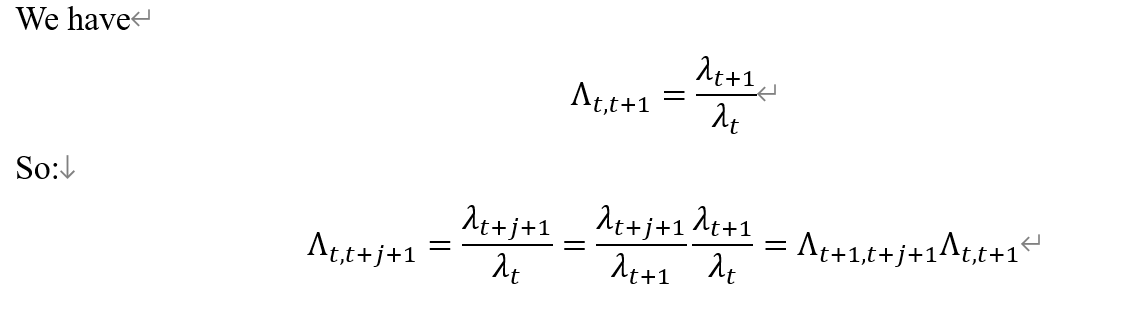
Thanks @Bandel! I understand how you get from the first to the second line. Could you please explain you can expand \Lambda\_{t,t+j+1} to find \Lambda\_{t,t+1} \Lambda\_{t+1,t+j+1} (i.e. going from the second to the third line)? Many thanks
---
### Author:  [@Bandel](https://forum.dynare.org/u/Bandel)
#### Post date: [6 April 2023 15:27 UTC](https://forum.dynare.org/t/gertler-karadi-2011-first-order-conditions/22219/8 "2023-04-06T15:27:47Z")
---
### Author:  [@Robert](https://forum.dynare.org/u/Robert)
#### Post date: [6 April 2023 15:56 UTC](https://forum.dynare.org/t/gertler-karadi-2011-first-order-conditions/22219/9 "2023-04-06T15:56:05Z")
Thanks @Bandel, I had a feeling that opening up \Lambda\_{t,t+1} could be another way to get your result - turns out it is. Let me have a look and get back to you. Thanks already for all your help!
---
### Author:  [@Robert](https://forum.dynare.org/u/Robert)
#### Post date: [7 April 2023 14:33 UTC](https://forum.dynare.org/t/gertler-karadi-2011-first-order-conditions/22219/10 "2023-04-07T14:33:41Z")
Hi @Bandel, can I just double check with you please how you get from the third to the final line, where you find the sum is equal to V\_{t+1}. In the third line you change the sum starting value back to 0 and \Lambda\_{t+1, t+1+i} becomes \Lambda\_{t+1,t+i} and N\_{j,t+1+i} becomes N\_{j,t+i} (my notation is slightly different than yours). So we find that:
V\_{j,t} = (1-\theta) \beta \Lambda\_{t,t+1} N\_{j,t+1} + \theta \beta \Lambda\_{t,t+1} \underbrace{ \sum\_{i = 0}^{\infty} (1-\theta) \theta^{i-1} \beta^{i} \Lambda\_{t+1,t+i} N\_{j,t+i} }\_{V\_{j,t+1}?}
How do you know that this sum is equal to V\_{j,t+1} and not V\_{j,t-1}. I plugged values in and I actually reach the conclusion that I’ve obtained the latter. This should hopefully be the last question I have, thanks!
---
### Author:  [@Bandel](https://forum.dynare.org/u/Bandel)
#### Post date: [8 April 2023 00:03 UTC](https://forum.dynare.org/t/gertler-karadi-2011-first-order-conditions/22219/11 "2023-04-08T00:03:45Z")
You can get this by comparing the change of the superscript of Vt